The Ultimate Guide to Preschool Options: Montessori, Waldorf, Reggio, and Traditional Compared
Choosing the right preschool for your child can feel overwhelming. With so many educational philosophies and approaches available—each claiming unique benefits—how do you determine which one will best support your child’s development and align with your family’s values?
In this comprehensive guide, we’ll explore the four major preschool approaches: Montessori, Waldorf, Reggio Emilia, and Traditional (both play-based and academic). We’ll break down their philosophies, teaching methods, and classroom environments, and help you determine which might be the best fit for your unique child.
Understanding the Major Preschool Philosophies
Montessori: Independence and Self-Directed Learning
Core Philosophy: Developed by Dr. Maria Montessori in the early 1900s, this approach views children as naturally eager to learn and capable of initiating learning in a supportive environment.
According to Brightwheel, the Montessori approach is “child-centered, where teachers act as guides and children learn at their own pace in mixed-age settings.”
Key Characteristics:
Self-directed learning with children choosing activities.
Specially designed materials that isolate specific skills.
Uninterrupted work periods (often 2-3 hours).
Focus on practical life skills, sensorial experiences, language, mathematics, and cultural studies.
Emphasis on independence and intrinsic motivation.
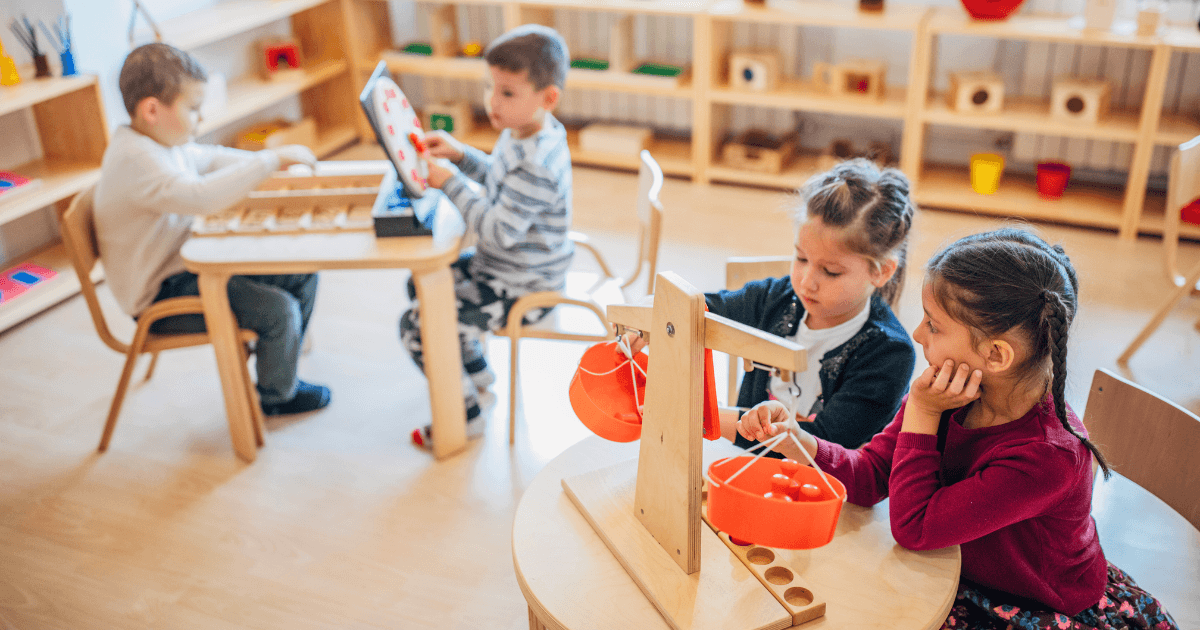
Classroom Environment: Montessori classrooms are carefully prepared with orderly, aesthetically pleasing materials arranged on open shelves. Materials progress from simple to complex and from concrete to abstract. The environment promotes independence with child-sized furniture and tools.
Teacher’s Role: Teachers (called “guides”) observe children, introduce materials when children show readiness, and then step back to allow independent exploration. They rarely lead whole-group activities, instead working with children individually or in small groups.
Waldorf: Imagination, Rhythm, and Artistic Expression
Core Philosophy: Founded by Rudolf Steiner in the early 20th century, Waldorf education emphasizes the development of the whole child—head, heart, and hands—through artistic and practical activities.
Our Kids notes that Waldorf “emphasizes a play-based approach, integrating arts, gardening, and movement, with formal academics typically starting around age seven.”
Key Characteristics:
Strong emphasis on rhythm and routine
Delayed academic instruction until around age 7
Integration of the arts throughout all learning
Limited technology, with emphasis on natural materials
Focus on imaginative play and storytelling
The same teacher stays with a class for multiple years
Teacher’s Role: Teachers create a rhythmic day with alternating periods of expansion (active play) and contraction (quiet focus). They lead the class through songs, movement, and stories, serving as a model for imitation rather than providing direct instruction.
Reggio Emilia: Project-Based Collaboration
Core Philosophy: Originating in the Italian town of Reggio Emilia after World War II, this approach views children as capable, curious individuals with great potential and a drive to understand their world.
Ann Arbor Family explains that Reggio Emilia “focuses on small class sizes, play-based experiences, and collaboration among children, parents, and teachers.”
Key Characteristics:
Project-based learning following children’s interests
Documentation of children’s work and learning processes
The environment is viewed as the “third teacher”
Strong parent and community involvement
The “hundred languages of children” (multiple ways of expressing thoughts and creativity)
Emergent curriculum that develops from children’s ideas
Classroom Environment: Reggio-inspired classrooms are thoughtfully arranged with natural light, plants, and materials that invite exploration. Documentation of children’s work is prominently displayed, and spaces are designed to promote collaboration and communication.
Teacher’s Role: Teachers are co-learners and researchers alongside children, documenting children’s thinking, asking thoughtful questions, and providing resources to extend investigations. They collaborate closely with colleagues to reflect on and plan experiences.
Traditional Preschool: Structured Learning Experiences
Traditional preschools vary widely but generally fall into two main categories:
Play-Based Traditional
Core Philosophy: Play-based traditional preschools emphasize learning through play while providing some structure and teacher-guided activities.
CCAVERO notes that “play-based curriculum significantly enhances children’s cognitive development through hands-on exploration and discovery.”
Key Characteristics:
Balance of free play and teacher-led activities
Learning centers for different types of play (blocks, dramatic play, art, etc.)
Social skills development through group activities
Predictable daily schedule
Preparation for kindergarten through playful learning
Introduction to academic concepts through games and hands-on activities
Classroom Environment: Classrooms typically feature distinct learning centers with themed materials, colorful displays, and child-sized furniture. Materials rotate to maintain interest and reflect seasonal or thematic units.
Teacher’s Role: Teachers plan activities based on developmental goals, lead group times (circle time, story time), and facilitate play. They provide a mix of direct instruction and child-led exploration.
Academic Traditional
Core Philosophy:Academic traditional preschools focus on explicit instruction in pre-academic skills to prepare children for kindergarten.
According to Vera Preschools, this approach is “organized and teacher-directed, emphasizing academic preparedness and skill development.”
Key Characteristics:
Structured curriculum with specific learning objectives
Direct instruction in pre-reading, writing, and math skills
Regular assessment of skill development
Whole-group instruction balanced with individual practice
Classroom Environment: Classrooms often resemble elementary settings with designated work areas, alphabet and number displays, and materials organized for specific learning activities. There may be more worksheets and fewer open-ended materials than in other approaches.
Teacher’s Role: Teachers lead instruction, demonstrate skills, and assess children’s progress toward specific academic benchmarks. They follow a planned curriculum and provide feedback on children’s work.
Comparing Key Elements Across Approaches
Curriculum Focus and Structure
Montessori:
Individualized learning paths following each child’s interests and readiness
Curriculum is divided into five key areas: Practical Life, Sensorial, Mathematics, Language, and Cultural Studies
Sequential materials with built-in control of error
Children progress at their own pace, often working independently
Indoor and outdoor spaces are connected and equally valued
Play-Based Traditional:
Colorful, stimulating environment with defined learning centers
Mix of commercial and teacher-created materials
Variety of toys, games, and art supplies
Materials rotated to maintain interest and reflect themes
Outdoor play equipment for gross motor development
Academic Traditional:
More structured classroom arrangement
Learning materials organized by subject area
Educational posters and displays (alphabet, numbers, etc.)
Materials selected to support specific learning objectives
Designated spaces for group instruction and individual work
Which Approach Might Best Suit Your Child?
While every child is unique, certain temperaments and learning styles may align better with specific approaches:
Consider Montessori if your child:
Is naturally independent and self-motivated
Enjoys order and organization
Prefers to work at their own pace
Has a long attention span for activities that interest them
Shows interest in practical life skills
Thrives with freedom of choice within limits
Consider Waldorf if your child:
Has a vivid imagination
Enjoys storytelling and pretend play
Benefits from consistent routines and rhythms
Is sensitive to their environment
Thrives with artistic and musical experiences
Needs time to develop social confidence
Consider Reggio Emilia if your child:
Is naturally curious and investigative
Enjoys collaborative projects
Expresses ideas in multiple ways (art, movement, building)
Thrives with a responsive, evolving curriculum
Has strong verbal communication skills
Enjoys documenting and revisiting their work
Consider Play-Based Traditional if your child:
Benefits from a balance of structure and free choice
Enjoys varied activities and materials
Thrives with a gentle introduction to academic concepts
Needs support in developing social skills
Responds well to thematic learning
Adapts well to group activities
Consider Academic Traditional if your child:
Thrives with clear expectations and routines
Shows early interest in letters, numbers, and writing
Benefits from direct instruction and feedback
Enjoys structured learning activities
Needs preparation for a traditional kindergarten
Responds well to achievement recognition
Practical Considerations for Parents
Authenticity and Implementation
It’s important to note that schools may use philosophy names but vary in how faithfully they implement the approach. When visiting schools:
Ask about teacher training in the specific approach
Observe how closely classroom practices align with the philosophy
Look for key elements of the approach in action
Ask how the school measures quality and fidelity to the approach
Transitions to Kindergarten
Consider how each preschool approach prepares children for their likely kindergarten experience:
Montessori to traditional kindergarten: Children may need to adjust to more teacher-directed learning and whole-group instruction.
Waldorf to traditional kindergarten: Children may encounter academic expectations they haven’t been formally prepared for.
Reggio Emilia to traditional kindergarten: Children may need to adapt to a more structured curriculum with less input into learning topics.
Play-based-to-academic kindergarten: The transition is typically smoother but may still require adjustment to increased academic expectations.
Academic Traditional to kindergarten: Often the smoothest academic transition, though children may have had less experience with self-directed learning.
Cost and Accessibility
Different approaches vary in cost and availability:
Montessori: Ranges from affordable public programs to expensive private schools; quality varies widely.
Waldorf: Typically private and can be costly; fewer options in many communities.
Reggio Emilia: Often found in higher-end private schools or lab schools; true Reggio programs are relatively rare in the U.S.
Play-Based Traditional: Available in both public and private settings across price points.
Academic Traditional: Widely available in both public and private settings across price points.
Questions to Ask When Visiting Schools
Regardless of approach, consider asking:
What specific training do teachers have in this educational approach?
How do you assess children’s development and learning?
How do you handle behavioral challenges?
What does parent involvement look like in your program?
How do you support diverse learning needs?
What does a typical day look like?
What percentage of your graduates attend each type of kindergarten program?
How do you prepare children for the transition to kindergarten?
Hybrid and Blended Approaches
Many schools today incorporate elements from multiple philosophies. According to Ivybrook Academy, some programs intentionally “blend the Montessori and Reggio Emilia approaches” to create a hybrid model.
These blended programs might offer:
Montessori materials within a Reggio-inspired project approach
Waldorf-inspired artistic elements in a more academic framework
Play-based learning with elements of multiple alternative approaches
When considering a hybrid program, ask specifically how the different philosophies are integrated and what aspects of each approach are prioritized. According to Jabaloo, effective hybrid combinations include:
Montessori + Reggio Emilia
This combination often features:
Montessori’s structured materials and independent work time
Reggio’s project-based investigations and documentation
A balance between individual choice and collaborative projects
Greater emphasis on creativity while maintaining structure
Documentation of learning alongside mastery of skills
This hybrid works well for children who benefit from structure but also thrive with creative expression and collaborative projects.
Montessori + Waldorf
This blend typically includes:
Montessori’s focus on reality-based materials and independence
Waldorf’s emphasis on rhythm, imagination, and artistic expression
Natural materials from both traditions
A balance of practical skills and imaginative play
Less academic pressure than pure Montessori, more structure than pure Waldorf
This combination can be ideal for children who need hands-on, concrete learning experiences but also benefit from artistic expression and imaginative play.
Waldorf + Reggio Emilia
This approach often combines:
Waldorf’s focus on rhythm, storytelling, and artistic expression
Reggio’s project-based learning and documentation
Strong emphasis on creativity and expression
Community-centered approach to learning
Integration of nature and seasonal themes into projects
This hybrid works well for creative, expressive children who thrive in collaborative environments with less emphasis on academic skills.
Traditional + Alternative Approaches
Many mainstream preschools incorporate elements of alternative approaches:
Play-based programs with Reggio-inspired documentation
Academic programs with Montessori-inspired choice time
Traditional curricula with Waldorf-inspired artistic elements
These programs often appeal to parents who want some alternative elements but within a more familiar educational framework.
Creating Your Own Hybrid Approach at Home
Even if you choose a single approach for your child’s preschool, you can complement it at home with elements from other philosophies. As Lovevery suggests, parents can successfully integrate elements from multiple philosophies to create a personalized educational experience.
For example:
If your child attends a Montessori school, you might incorporate Waldorf-inspired storytelling and seasonal celebrations at home.
If your child is in a traditional academic preschool, you might create a Reggio-inspired project area at home to document their interests.
If your child attends a Waldorf program, you might provide some Montessori-inspired practical life activities at home.
The key is to understand the core principles of each approach and thoughtfully select elements that complement your child’s school experience and address their individual needs.
Making Your Final Decision
With so many options, how do you make the right choice? Consider these steps:
Reflect on your child’s temperament and learning style. Observe how they naturally approach learning and play.
Consider your family’s values and priorities. What aspects of education matter most to you? Academic preparation? Creativity? Independence? Social skills?
Visit multiple programs. Seeing different approaches in action can clarify which environment feels right for your child.
Talk with parents whose children attend different programs. Their experiences can provide valuable insights.
Consider practical factors. Location, cost, hours, and availability all impact your decision.
Trust your instincts. After doing your research, pay attention to which approach resonates most with your understanding of your child.
Remember that no approach is perfect for every child, and the quality of implementation often matters more than the specific philosophy. A mediocre Montessori program may be less beneficial than an excellent traditional program, regardless of your preference for the Montessori philosophy.
Conclusion: Finding the Right Fit
The best preschool approach for your child is one that honors their unique personality, supports their developmental needs, and aligns with your family’s values. Whether you choose Montessori, Waldorf, Reggio Emilia, a traditional approach, or a hybrid model, what matters most is that your child feels safe, respected, and engaged in their learning journey.
By understanding the philosophies and practices of different approaches, you can make an informed decision that sets your child on a path to becoming a confident, curious, and capable learner—regardless of which educational path you choose.
Have you experienced any of these preschool approaches with your child? Share your insights in the comments below!