Math in the Kitchen: Cooking Activities That Teach Measurement and Counting
The kitchen is perhaps the most math-rich environment in your home—a place where numbers, measurements, fractions, and proportions come alive through everyday cooking activities. While worksheets and flashcards have their place, nothing compares to the hands-on, multisensory learning that happens when children measure, mix, and create in the kitchen.
Research supports this approach: Mathnasium reports that preschoolers who practice math through cooking demonstrate stronger mathematical thinking. In contrast, fourth graders in cooking-based math programs show measurable gains in math knowledge. The kitchen truly is the perfect classroom for developing essential math skills.
Let’s explore how cooking activities can transform abstract math concepts into delicious learning opportunities for children of all ages.
Foundational Math Skills Developed Through Cooking
Before diving into specific activities, it’s helpful to understand the wide variety of math concepts naturally embedded in cooking:
Counting and Number Sense
Counting ingredients (3 eggs, 12 muffin cups)
Understanding one-to-one correspondence (one measuring cup per ingredient)
Recognizing numerals on measuring tools and recipes
Measurement
Using standard units (cups, tablespoons, ounces)
Understanding volume and capacity
Comparing weights and sizes
Fractions and Proportions
Visualizing what ½ or ¼ cup looks like
Understanding that four ¼ cups equal one whole cup
Doubling or halving recipes
Time and Sequence
Following the steps in order
Tracking cooking and cooling times
Understanding “before” and “after” concepts
Estimation and Prediction
Estimating how many cookies a batch will make
Predicting how ingredients will change during cooking
Guessing measurements before checking
Age-Appropriate Kitchen Math Activities
The beauty of kitchen math is that it can be tailored to any age or developmental level. Here’s how to engage children from toddlerhood through the teen years:
For Toddlers and Preschoolers (Ages 2-4)
At this stage, focus on counting, basic comparisons, and sensory exploration.
1. Counting Cookies
Materials: Cookie dough, baking sheet
Math Skills: Counting, one-to-one correspondence
Activity: Have your child count each cookie as they place it on the baking sheet. Ask questions like, “How many cookies are in this row?” or “Can you put three cookies on this side?” For additional learning, count the cookies again after baking to reinforce the conservation of number (the idea that the quantity stays the same even when the appearance changes).
2. Sorting Snack Mix
Materials: Various cereals, dried fruits, nuts (age-appropriate), muffin tin
Math Skills: Sorting, categorizing, counting
Activity: Place different ingredients in separate sections of a muffin tin. Have your child count out specific numbers of each item to create their own snack mix. “Can you put 5 Cheerios, 3 raisins, and 2 pretzels in your bowl?” This activity builds counting skills while introducing the concept of recipes as sets of instructions.
3. Fill and Dump Measuring
Materials: Measuring cups, large bowl, rice or dried beans
Math Skills: Volume comparison, sensory exploration
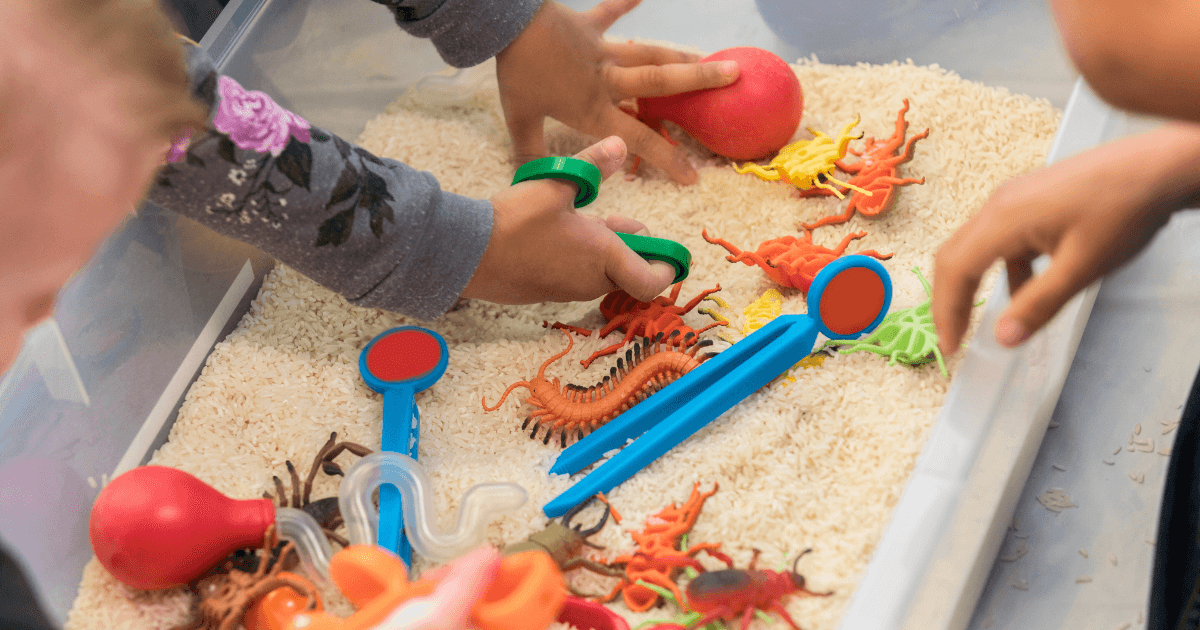
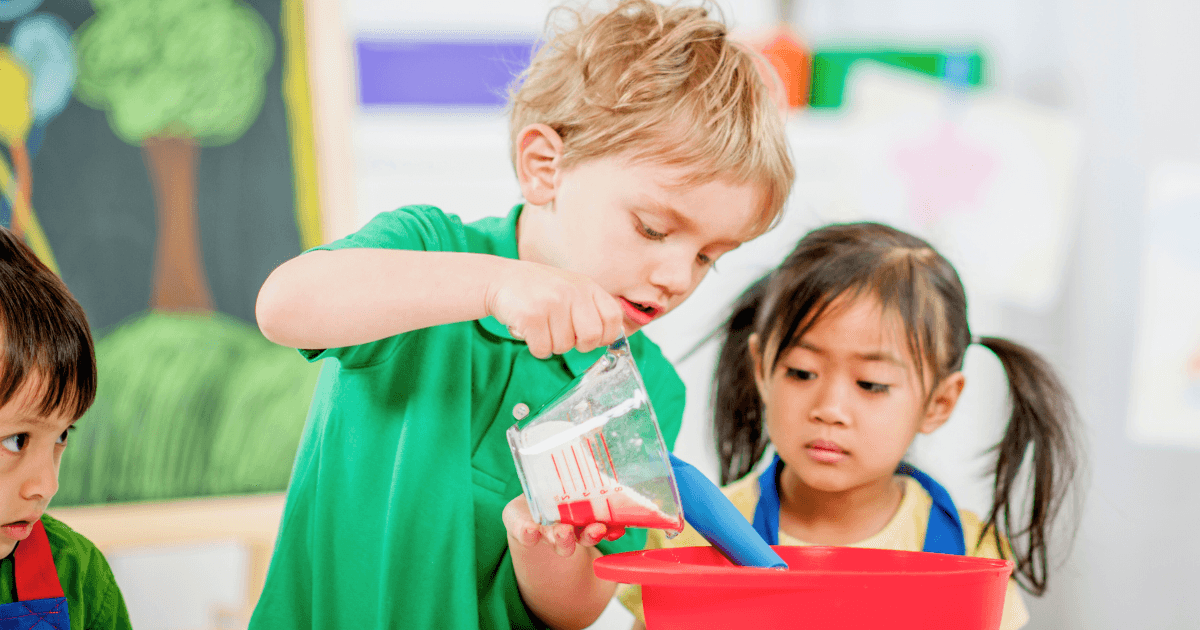
Activity: Let your child explore different-sized measuring cups by filling and dumping rice or beans into a bowl. Introduce language such as “more” and “less,” “full” and “empty,” and “big” and “small.” This lays the foundation for understanding measurement concepts.
For Early Elementary (Ages 5-7)
Children at this age are ready for more structured measurement activities and basic fractions.
4. Measuring Scavenger Hunt
Materials: Various measuring tools (cups, spoons, scale), ingredient list
Math Skills: Tool identification, measurement vocabulary
Activity: Create a simple scavenger hunt in which children find the appropriate measuring tool for each ingredient. “Can you find the tool we need to measure ½ cup of flour? How about 1 tablespoon of oil?” This helps children become familiar with different measuring tools and their purposes.
Activity: While making pancakes, demonstrate that two ¼-cup scoops of flour equal ½ cup, and two ½-cup scoops equal 1 cup. Then make pancakes of different sizes and cut them into halves and quarters to create a concrete representation of fractions that children can both see and eat!
Activity: Start with a very simple recipe and work together to double it. “If we need 1 cup of water for one batch, how much do we need for two batches?” This introduces the practical application of doubling numbers.
For Upper Elementary (Ages 8-10)
These children are ready for more complex measurement concepts, including equivalencies and conversions.
Activity: Take a simple recipe and challenge your child to make it using only certain measuring tools. For example, if you need ¼ cup of oil but can only use tablespoons, you’ll need to figure out that ¼ cup equals 4 tablespoons. This practically reinforces measurement equivalencies.
Activity: Practice multiplying and dividing fractions by scaling recipes up or down. If a recipe serves 4 but you need to serve 6, how would you adjust the ingredients? This real-world application makes fraction operations meaningful.
9. Cooking Time Management
Materials: Recipe with multiple steps, timer, paper for planning
Math Skills: Time calculation, planning, sequencing
Activity: For a multi-step recipe, have your child work backward from the desired serving time to determine when each step needs to occur. “If dinner is at 6:00 and the casserole needs to bake for 45 minutes, when should we put it in the oven? What about the 15 minutes of prep time before that?”
For Middle School and Beyond (Ages 11+)
Older children can tackle more sophisticated mathematical thinking through cooking.
10. Recipe Ratios
Materials: Basic recipes that demonstrate ratios (like salad dressing, which often uses a 3:1 oil to vinegar ratio)
Math Skills: Ratios, proportional reasoning
Activity: Explore how ratios work by making and adjusting basic recipes. If a vinaigrette calls for 3 parts oil to 1 part vinegar, how much of each would you need for different serving sizes? How would the taste change if you altered the ratio?
11. Cost Analysis
Materials: Recipe, grocery store flyers or online shopping site, calculator
Math Skills: Multiplication, division, budgeting
Activity: Calculate the cost per serving for a favorite recipe. Have your child look up the price of each ingredient and determine how much of each is used in the recipe. This introduces concepts of unit pricing and budgeting.
12. Recipe Development
Materials: Basic recipe template, various ingredients, measuring tools
Math Skills: Proportional reasoning, experimentation
Activity: Challenge older children to develop their own recipe by understanding the basic proportions needed (for example, the ratio of flour to liquid in quick bread recipes). This applies mathematical thinking to creative problem-solving.
Everyday Kitchen Math Moments
Beyond specific activities, everyday cooking offers countless opportunities to reinforce math concepts:
During Meal Preparation
Count items as you take them out of the refrigerator
Discuss the shapes of different foods
Use comparative language: bigger/smaller, more/less, heavier/lighter
Talk through measurement as you cook: “I’m adding ½ teaspoon of salt”
During Grocery Shopping
Compare prices and sizes
Weigh produce and estimate costs
Calculate discounts during sales
Track running totals while shopping
During Mealtime
Count items on plates
Divide food into equal portions
Discuss fractions when cutting pizza, sandwiches, or cake
Estimate how much food will be left after everyone takes a serving
Making Kitchen Math Accessible for All Learners
Children have different learning styles, and the kitchen offers opportunities to engage various strengths:
For Visual Learners
Use clear measuring cups with visible markings
Create visual recipe cards with pictures of each step
Use color-coding for different measuring tools
Demonstrate techniques before having children try them
For Auditory Learners
Talk through measurements and steps
Create rhythmic counting patterns while stirring or mixing
Ask children to repeat instructions back to you
Create songs or rhymes to remember measurement equivalents
For Kinesthetic Learners
Provide hands-on experience with every step possible
Use whole-body movements to demonstrate concepts (arms out wide for “1 cup,” hands close together for “1teaspoon”)
Allow for sensory exploration of ingredients
Use hand-over-hand guidance for new skills
Favorite Math-Rich Recipes for Children
Some recipes are particularly well-suited for math learning. Here are a few favorites:
1. Counting Trail Mix
Perfect for young counters, this customizable snack lets children practice one-to-one correspondence with delicious results.
Ingredients (per serving):
10 cereal pieces
5 small pretzels
8 raisins or dried cranberries
6 chocolate chips
3 almonds or other nuts (if age-appropriate)
Math Opportunities:
Counting specific quantities
Creating patterns
Comparing amounts
Simple addition (“How many pieces altogether?”)
2. Fraction Pizzas
Individual pizzas provide a concrete way to explore fractions while creating a meal.
Ingredients:
English muffins or pita bread
Pizza sauce
Shredded cheese
Various toppings
Math Opportunities:
Dividing pizzas into halves, quarters, or eighths
Measuring ingredients using fraction cups
Calculating how much of each topping for multiple pizzas
Comparing fractions (“Which is more: ¼ cup of cheese or ⅛ cup?”)
3. Measurement Muffins
This basic muffin recipe uses multiple units of measurement and can be customized with different mix-ins.
Ingredients:
2 cups flour
1 tablespoon baking powder
½ teaspoon salt
¼ cup sugar
1 cup milk
⅓ cup vegetable oil
1 egg
Mix-ins as desired (berries, chocolate chips, etc.)
Math Opportunities:
Using different measuring tools
Practicing with fractions
Doubling or halving the recipe
Dividing batter equally among muffin cups
Timing the baking process
Common Kitchen Math Mistakes (And Learning Opportunities)
Mistakes in the kitchen provide valuable learning moments. Here are common errors and how to turn them into teaching opportunities:
Mistake: Confusing Tablespoons and Teaspoons
Learning Opportunity: Explore the relationship between these measurements. Show that 1 tablespoon equals 3 teaspoons by measuring water and transferring it between the two.
Mistake: Not Leveling Dry Ingredients
Learning Opportunity: Demonstrate the difference between a heaping cup and a level cup by weighing both. This introduces the concept of standardized measurement.
Mistake: Using Liquid and Dry Measuring Cups Interchangeably
Learning Opportunity: Compare the volume of a dry measuring cup and a liquid measuring cup of the same stated size. Discuss why different tools exist for different ingredients.
Mistake: Misreading Fractions in Recipes
Learning Opportunity: Create a fraction wall or chart to keep in the kitchen that shows equivalent fractions and their decimal representations.
The Social-Emotional Benefits of Kitchen Math
Beyond academic skills, cooking together builds important life skills:
Confidence: Successfully following a recipe builds self-efficacy
Patience: Waiting for food to cook teaches delayed gratification
Precision: Understanding that accuracy matters for good results
Problem-solving: Figuring out solutions when things don’t go as planned
Cooperation: Working together toward a common goal
Tips for Success
To make kitchen math experiences positive and productive:
Start simple: Begin with recipes that have few ingredients and steps
Prepare ahead: Measure complex ingredients in advance for very young children
Expect messes: Use washable surfaces and have cleaning supplies ready
Be patient: The learning process is more important than a perfect result
Ask questions: “How many more do we need?” “What would happen if…?” “How could we solve this problem?”
Connect to school: “You’re using fractions just like in math class!”
Celebrate effort: Acknowledge the process, not just the final product
From Kitchen to Classroom: Making Connections
The math skills developed in the kitchen directly support classroom learning:
Number sense supports computation fluency
Measurement builds understanding of the metric and customary systems
Fractions provide a foundation for later work with rational numbers
Problem-solving develops mathematical thinking and reasoning
Estimation builds number sense and reasonableness of answers
According to Stanford’s Family Math program, these everyday math experiences are crucial for building children’s mathematical confidence and competence.
Conclusion: The Recipe for Math Success
The kitchen offers the perfect blend of ingredients for mathematical learning: hands-on experiences, real-world applications, immediate feedback, and delicious results. By incorporating these activities into your cooking routine, you’re not just making meals—you’re building mathematical minds.
The best part? Children won’t even realize they’re doing math—they’ll know they’re having fun creating something delicious. And that positive association with mathematical thinking is perhaps the most valuable outcome of all.
What are your favorite ways to incorporate math learning in the kitchen? Share your ideas and experiences in the comments below!