Loose Parts Play: Open-Ended Materials That Spark Creativity
I’ll never forget the day I walked into my classroom to find five-year-old Emma meticulously arranging a collection of bottle caps, pebbles, and fabric scraps. When I asked what she was creating, she looked up with bright eyes and said, “It’s a map of my dream garden where butterflies can have meetings.” That moment crystallized for me the magic of loose parts play—where ordinary objects transform into extraordinary possibilities through a child’s imagination.
In a world increasingly dominated by structured activities and screen time, loose parts play offers a refreshing return to creative, child-directed exploration. But what exactly are “loose parts,” and why have they become such a powerful force in early childhood education? Let’s dive into this fascinating approach that’s transforming how children play and learn.
What Are Loose Parts?
The term “loose parts” was first coined by architect Simon Nicholson in his 1971 theory of loose parts, where he proposed that “in any environment, both the degree of inventiveness and creativity, and the possibility of discovery, are directly proportional to the number and kind of variables in it.”
In simpler terms, loose parts are open-ended materials that can be moved, carried, combined, redesigned, lined up, taken apart, and put back together in multiple ways. They have no specific set of directions and can be used alone or combined with other materials.
Examples include:
Natural materials:
- Sticks, stones, and pinecones
- Shells and seed pods
- Leaves, petals, and bark
- Sand, dirt, and clay
Manufactured materials:
- Bottle caps and buttons
- Fabric scraps and ribbon
- Cardboard tubes and boxes
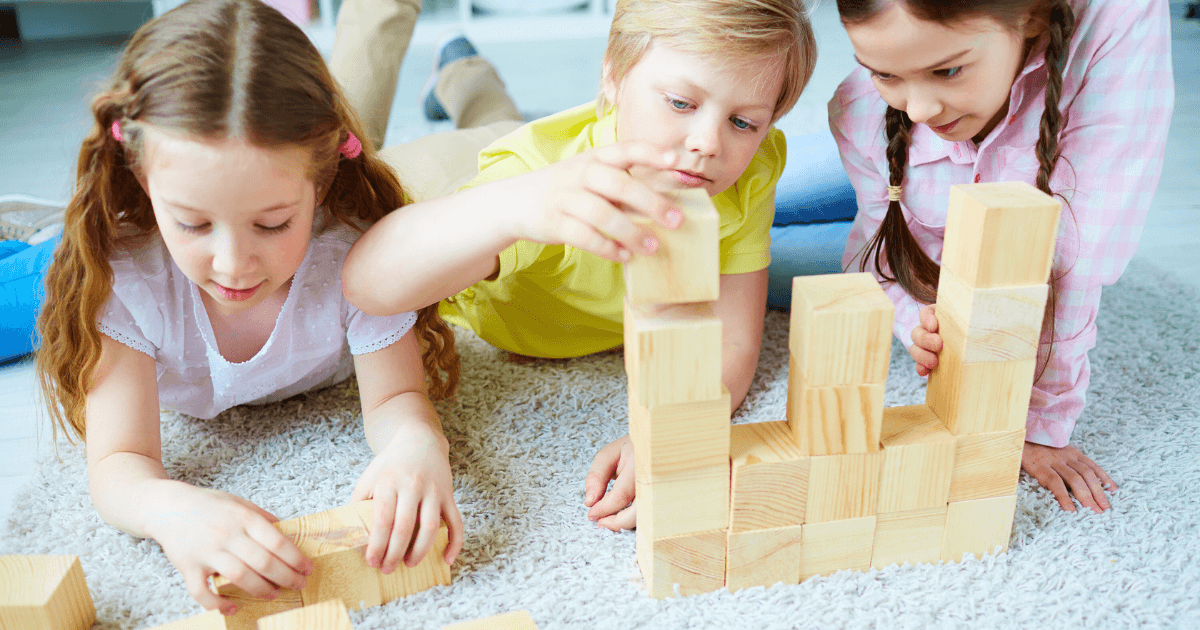
- Wooden blocks and spools
Recycled materials:
- Plastic containers and lids
- Metal washers and nuts
- Paper rolls and cardboard
- Corks and bottle tops
The beauty of loose parts is that they’re often free or low-cost, making this approach accessible to virtually any learning environment or home.
The Profound Benefits of Loose Parts Play
Research consistently shows that loose parts play offers remarkable developmental benefits for children. According to a 2024 study published in the Journal of Early Childhood Research, children engaged in loose parts play demonstrate significantly higher levels of creative thinking and problem-solving compared to those using only structured toys.
Cognitive Development
Loose parts play engages children’s minds in powerful ways:
- Problem-solving: When a child tries to balance stones or create a structure from sticks, they’re engaging in real-time engineering and physics experiments.
- Mathematical thinking: Sorting, classifying, and patterning with loose parts builds foundational math concepts.
- Spatial reasoning: Arranging materials in space helps children develop an understanding of dimension, area, and volume.
- Critical thinking: There’s no “right way” to use loose parts, encouraging children to think flexibly and try multiple approaches.
As Dr. Rachel White, developmental psychologist at Hamilton College, explains, “When children use loose parts, they’re constantly making predictions, testing hypotheses, and revising their thinking—the very essence of scientific reasoning.”
Creative Expression
Unlike toys with predetermined uses, loose parts invite endless creative possibilities:
- They can be anything the child imagines
- They encourage original thinking and innovation
- They allow for personal expression without “right” or “wrong” outcomes
- They evolve with the child’s interests and developmental stage
One preschool teacher shared with me, “I’ve seen the same collection of wooden discs become cookies in a bakery, coins in a treasure chest, and planets in a solar system—all in the same day with different children.”
Social-Emotional Growth
Loose parts play naturally supports children’s emotional development:
- Autonomy: Children direct their own play and make their own decisions
- Confidence: Success with open-ended materials builds self-efficacy
- Collaboration: When playing together, children negotiate, share ideas, and solve problems collectively
- Emotional regulation: The focused nature of loose parts play helps children develop concentration and persistence
Physical Development
Manipulating loose parts offers excellent physical benefits:
- Fine motor skills: Picking up, placing, and manipulating small objects
- Hand-eye coordination: Aligning and balancing materials
- Gross motor development: Carrying, arranging, and constructing with larger loose parts
- Sensory integration: Experiencing different textures, weights, and properties
Setting Up for Successful Loose Parts Play
Whether you’re a parent, teacher, or caregiver, implementing loose parts play can be simple and rewarding. Here’s how to get started:
Gathering Materials
Begin your collection with these approaches:
- Start small: Don’t feel pressured to amass a huge collection immediately. Begin with what you have on hand.
- Look around you: Everyday items like bottle caps, fabric scraps, and cardboard can form the foundation of your collection.
- Embrace nature: Take children on “collecting walks” to gather pinecones, interesting sticks, smooth stones, and fallen leaves.
- Community resources: Reach out to local businesses for donations of safe materials like wood scraps, fabric remnants, or bottle caps.
- Safety first: Ensure all materials are clean, free of sharp edges, and appropriate for the age group (being mindful of choking hazards for young children).
As noted by the National Association for the Education of Young Children, “The best loose parts collections grow gradually and reflect children’s interests and the local environment.”
Creating Inviting Spaces
The presentation of materials significantly impacts children’s engagement:
- Accessibility: Store materials in clear, open containers at child height
- Organization: Group similar items together to help children see possibilities
- Aesthetics: Present materials attractively—try sorting by color, size, or type
- Space: Provide ample room for children to spread out and work
- Rotation: Periodically change available materials to maintain interest
Supporting Without Directing
The adult role in loose parts play requires a delicate balance:
- Observe: Watch how children interact with materials before intervening
- Ask open-ended questions: “I wonder what would happen if…” or “How else might you use that?”
- Provide language: Help children describe their creations and processes
- Document: Take photos or notes about children’s creations to revisit later
- Resist the urge to direct: Allow children to determine how materials are used
Loose Parts Play Across Ages
One of the beautiful aspects of loose parts is their adaptability across developmental stages:
Infants and Toddlers (0-2 years)
For our youngest explorers, loose parts play focuses on sensory exploration and discovery:
- Offer larger, mouthable items like fabric squares, large wooden rings, or smooth stones (always supervised)
- Provide containers for filling and dumping
- Create treasure baskets with diverse textures and natural materials
- Focus on open-ended exploration rather than construction
Preschoolers (3-5 years)
At this age, loose parts become tools for representation and storytelling:
- Encourage creation of patterns and designs
- Support dramatic play with loose parts as props
- Introduce sorting and categorizing activities
- Provide opportunities for collaborative creation
School-Age Children (6-8 years)
Older children use loose parts for more complex purposes:
- Challenge them to create specific structures or solve design problems
- Introduce loose parts in conjunction with science concepts
- Encourage documentation of their process through drawing or writing
- Incorporate loose parts into mathematical explorations
Inspiring Loose Parts Play: Provocations and Invitations
While loose parts play is child-directed, thoughtfully designed “invitations to play” can spark engagement:
Simple Provocations to Try
- Pattern Possibilities: Create the beginning of a pattern with stones, sticks, or buttons and leave space for children to continue or adapt it.
- Loose Parts Letters: Outline a letter, number, or shape on paper and invite children to fill it with small loose parts.
- Nature Frames: Place wooden frames or hula hoops outdoors and see how children fill them with natural materials.
- Light Table Explorations: If you have access to a light table, transparent and translucent loose parts create magical experiences.
- Story Starters: Place a picture book alongside related loose parts (e.g., “The Three Little Pigs” with building materials).
As early childhood educator Lisa Daly notes, “The most powerful provocations often combine familiar materials in unfamiliar ways or introduce new materials to a familiar context.”
Overcoming Common Challenges
While loose parts play offers tremendous benefits, it does come with some challenges:
“But it’s messy!”
Yes, creative exploration can be messy! Try these strategies:
- Define clear spaces for loose parts play
- Use trays or mats to contain smaller items
- Establish simple cleanup routines
- Remember that organization skills are part of the learning
“What about safety concerns?”
Safety is always paramount:
- Always supervise young children with small parts
- Regularly inspect materials for damage or hazards
- Be mindful of allergies with natural materials
- Clean and sanitize materials regularly
“Parents/administrators don’t understand the value”
Education is key:
- Document children’s learning through photos and notes
- Share articles about the benefits of loose parts play
- Invite skeptics to observe children’s engagement and creativity
- Connect loose parts play to learning standards and outcomes
The Future of Play is Open-Ended
In our rapidly changing world, the skills fostered by loose parts play—creativity, adaptability, problem-solving, and collaboration—are more valuable than ever. As educational consultant Sir Ken Robinson famously said, “Creativity is as important in education as literacy, and we should treat it with the same status.”
Loose parts play represents a return to fundamentals—allowing children to follow their curiosity, test ideas, and create meaning from the world around them. In the process, they develop not just academic skills but the creative confidence to approach challenges with resourcefulness and imagination.
Whether you’re a parent looking to enrich your home environment or an educator redesigning your learning spaces, loose parts offer an accessible, sustainable, and deeply effective approach to supporting children’s natural drive to learn through play.
The next time you’re about to recycle that cardboard tube or toss those bottle caps, pause and consider: could these become the raw materials for a child’s next great discovery?
What everyday materials have you seen transformed through children’s imagination? Share your loose parts play experiences in the comments below!