Music Beyond Singing: Introducing Instruments and Composition
While singing forms the foundation of many early music programs, there’s a vast musical world beyond vocal exploration waiting to be discovered. Introducing young children to instruments and composition not only broadens their musical horizons but also develops their critical thinking, fine motor skills, listening skills, and creative expression.
“When we limit music education to singing alone, it’s like teaching art with only one color,” explains music educator Maya Rodriguez. “Instruments and composition open up the full spectrum of musical possibilities, allowing children to become creators and innovators rather than just performers.”
Let’s explore practical, engaging ways to introduce instruments and composition to children, creating a rich musical environment that goes beyond singing to embrace the full spectrum of musical experience.
The Benefits of Moving Beyond Singing
According to Responsive Classroom, expanding music education beyond vocal activities offers numerous developmental advantages:
Introducing Instruments: From Exploration to Performance
The journey from first touching an instrument to playing music involves several developmental stages. Here’s how to guide children through this progression:
Stage 1: Sound Exploration (Ages 3-5)
At this stage, focus on discovery and experimentation with sound sources.
Activity: Sound Scavenger Hunt
Materials: Various classroom objects that make interesting sounds
Process:
Gather the children in a circle
Demonstrate how different objects make different sounds
Invite children to find objects that make interesting sounds
Create a “found sounds” display where children can explore
Activity: Instrument Petting Zoo
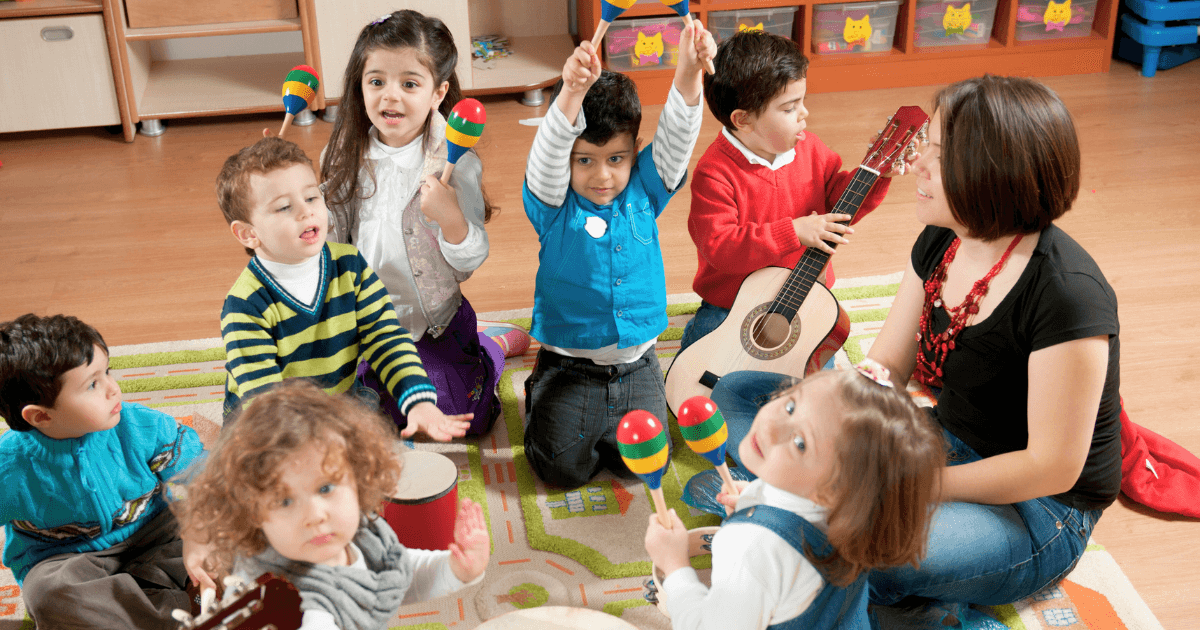
Materials: A variety of simple instruments (drums, shakers, bells, etc.).
Process:
Introduce each instrument one at a time
Demonstrate proper handling and basic playing technique
Allow children to explore each instrument freely
Guide them to notice differences in sound, texture, and playing methods
“I create’sound exploration stations’ in my classroom,” shares kindergarten teacher James Chen. “Each station has different instruments or sound-makers with picture cards showing how to handle them properly. Children rotate through stations, discovering new sounds while learning to respect the instruments.”
Stage 2: Rhythmic Foundations (Ages 4-7)
Build basic instrumental skills through rhythm activities.
Activity: Body Percussion Orchestra
Materials: None needed
Process:
Teach simple body percussion patterns (clap, pat, stomp, snap)
Create a visual chart showing different patterns
Divide the class into sections, each performing a different pattern
Conduct the “orchestra,” bringing sections in and out
Activity: Rhythm Sticks Conversation
Materials: Rhythm sticks for each child
Process:
Demonstrate simple rhythm patterns with sticks
Have children echo your patterns
Progress to “musical conversations” where you play a pattern, and children respond
Allow children to lead conversations with partners
Stage 3: Melodic Instruments (Ages 5-8)
Introduce simple melodic instruments with a limited number of notes.
Create a color-coded chart showing when each child should play
Progress from simple patterns to playing familiar melodies
Allow children to create their own color compositions
Activity: Xylophone Exploration
Materials: Xylophones with removable bars
Process:
Start with just 2-3 notes (typically C, E, G)
Teach simple patterns using these notes
Gradually add more notes as children become comfortable
Create simple accompaniments to familiar songs
According to Prodigies Music, starting with a limited number of notes builds confidence and allows children to experience success quickly before moving on to more complex playing.
Stage 4: Instrumental Ensembles (Ages 6-10)
Combine different instruments to create classroom ensembles.
Activity: Orff Ensemble
Materials: Variety of Orff instruments (xylophones, metallophones, glockenspiels)
Process:
Assign different parts based on difficulty level
Create simple ostinato patterns for each instrument group
Layer parts to create a full ensemble piece
Add body percussion or vocal elements
Activity: World Music Percussion Circle
Materials: Various percussion instruments from different cultures
Process:
Introduce instruments and their cultural origins
Teach basic technique for each instrument
Create layered rhythmic patterns inspired by different cultural traditions
Discuss how different cultures use rhythm and percussion
Introducing Composition: From Sound Stories to Original Pieces
Composition doesn’t have to be intimidating—even young children can create original music with the right scaffolding. Here’s a developmental progression for introducing composition:
Stage 1: Sound Stories (Ages 3-5)
Begin with narrative-based sound creation.
Activity: Weather Soundscape
Materials: Various percussion instruments
Process:
Discuss sounds associated with different weather (rain, thunder, wind)
Assign instruments to represent different weather elements
Identify key moments that could be enhanced with sound
Assign instruments to different characters or events
Perform the story with instrumental accompaniment
Stage 2: Pattern Composition (Ages 4-7)
Focus on creating and combining simple patterns.
Activity: Rhythm Block Composing
Materials: Cards with different rhythm patterns, recording device
Process:
Demonstrate each rhythm pattern
Have children arrange cards in different sequences
Perform the composed rhythm sequence
Experiment with different arrangements
Activity: One-Note Composition
Materials: Xylophones or other melodic instruments
Process:
Remove all bars except one note
Challenge children to create interesting rhythms using just one note
Focus on dynamics, tempo, and articulation
Combine individual patterns to create a class composition
I Can Compose recommends one-note composition as an excellent way to focus on rhythm, timbre, and expression without the complexity of managing multiple pitches.
Stage 3: Guided Composition (Ages 5-8)
Provide structured frameworks for composition.
Activity: Musical Mad Libs
Materials: Template with blanks for different musical elements
Process:
Create a template with spaces for rhythm, dynamics, tempo, and other elements.
Have children fill in the blanks with their choices.
Perform the resulting compositions.
Discuss how different choices affect the musical result.
Activity: Question and Answer Phrases
Materials: Melodic instruments with a pentatonic scale
Process:
Teach the concept of musical questions and answers
Provide a “question” phrase
Have children create “answer” phrases
Combine to create dialogues
Stage 4: Original Composition (Ages 6-10)
Support children in creating more independent compositions.
Activity: Collaborative Composition
Materials: Various instruments, composition worksheet
Process:
Divide the class into small groups
Provide categories to guide composition (e.g., rhythm, melody, dynamics).
Have each group create a short piece based on their choices
Perform and record final compositions
Activity: Graphic Score Creation
Materials: Large paper, markers, various instruments
Process:
Introduce the concept of graphic notation
Have children create visual representations of sounds
Translate graphic scores into performances
Experiment with different interpretations of the same score
“Graphic scores are magical for young composers,” explains music teacher Sofia Patel. “Children who might be intimidated by traditional notation can create sophisticated musical ideas through visual representation. I’ve seen incredible creativity emerge when we remove the barrier of conventional notation.”
Integrating Technology into Instrumental and Compositional Learning
Digital tools can enhance exploration of instruments and composition:
Digital Instruments and Apps
Chrome Music Lab: Free online tools for exploring sound, rhythm, and composition
GarageBand: Intuitive music creation software (iPad/Mac)
Incredibox: Playful beat-making app that introduces layering and arrangement
Soundtrap: Collaborative online recording studio for older students
Virtual Musical Instruments: Online simulations of instruments that children may not have physical access to
Use simple recording devices or apps to capture improvisations
Create music videos combining original compositions with visual art or movement
Share recordings with families to extend musical conversations beyond the classroom
Cross-Curricular Connections
According to Fun Music Co, instrumental music and composition naturally connect to other subject areas:
Mathematics
Explore patterns and sequences in compositions
Count beats, measures, and phrases
Identify symmetry in musical structures
Create compositions based on mathematical concepts
Language Arts
Compose musical settings for poems or stories
Create sound effects to enhance storytelling
Explore how music and text can convey similar emotions
Write lyrics for original melodies
Science
Investigate how instruments produce sound
Explore acoustics and sound waves
Create instruments from recycled materials
Compose music inspired by natural phenomena
Social Studies
Study instruments from different cultures
Create compositions inspired by historical events
Explore how music reflects cultural values
Compare musical traditions across time and place
Assessment and Documentation
Track musical growth through these assessment strategies:
Formative Assessment
Observation checklists for instrumental skills
Audio recordings of works in progress
Peer feedback sessions
Student self-reflection prompts
Summative Assessment
Performance of original compositions
Digital portfolios of compositions
Reflection on the creative process
Demonstration of specific instrumental techniques
Documentation Ideas
Create a classroom “composer’s corner” displaying works in progress
Maintain digital folders of recordings for each student
Host informal sharing sessions where students present their compositions
Create a year-end compilation of original music
Classroom Management for Instrumental Activities
Managing instruments and composition activities requires thoughtful planning:
Establishing Routines
Create clear procedures for distributing and collecting instruments
Establish signal systems for starting and stopping sound
Develop rotation systems for instrument exploration
Teach proper care and handling of instruments
Managing Sound Levels
Use visual volume monitors to help children self-regulate
Establish zones for different sound activities
Utilize headphones when appropriate for digital composition
Create hand signals for volume control
Grouping Strategies
Consider sound compatibility when grouping instruments
Create balanced ensembles with varied timbres
Use flexible grouping based on experience levels
Provide opportunities for both homogeneous and mixed instrument groups
Inclusive Approaches for All Learners
Ensure all children can access instrumental and compositional experiences:
Adaptations for Different Abilities
Modify instruments for children with physical limitations
Create color-coded notation systems for visual learners
Provide alternative ways to participate for children with sensory sensitivities
Offer multiple entry points for composition activities
Cultural Responsiveness
Include instruments from diverse cultural traditions
Explore compositional techniques from various musical cultures
Invite family and community members to share musical traditions
Acknowledge the origins of instruments and musical styles
Final Thoughts: Nurturing Young Musicians and Composers
When we expand music education beyond singing to include instrumental exploration and composition, we empower children as creative music-makers. These experiences lay the foundation for lifelong musical engagement, whether as performers, composers, or appreciative listeners.
As music educator Dr. Michael Torres observes, “The greatest gift we can give children is not just teaching them to play existing music, but helping them discover that they can create their own. When a child realizes ‘I am a composer,’ their relationship with music is transformed forever.”
By thoughtfully introducing instruments and composition in developmentally appropriate ways, we open doors to musical worlds that children might otherwise never discover—moving beyond singing to embrace the full spectrum of musical creation and expression.
What instrumental or compositional activities have been successful in your classroom? Share your experiences in the comments below!