Mindful Moments: Simple Breathing Exercises for Young Children
“I’m a volcano, and I’m going to EXPLODE!” four-year-old Zach announced, his face reddening as a classmate accidentally knocked over his block tower. Instead of the expected meltdown, something remarkable happened. His teacher calmly responded, “Let’s use our volcano breaths to cool down,” and Zach took three deep breaths with his arms rising and falling. The tension visibly melted from his small shoulders as he prepared to rebuild.
This moment—a potential crisis transformed into a learning opportunity—illustrates the power of mindful breathing in early childhood settings. As educators, we’ve all witnessed how quickly young children can become overwhelmed by emotions. Their developing nervous systems are still learning to process feelings, transitions, and frustrations. Mindful breathing offers a simple yet powerful tool to help children navigate these challenges.
According to research cited by Huckleberry Care, even 1-2 minutes of breathwork can yield significant benefits for children, including reduced stress, anxiety, reactivity, and challenging behaviors. Children as young as 2-3 years old can learn and benefit from simple breathing techniques, making these practices perfect for preschool settings.
In this article, we’ll explore playful, age-appropriate breathing exercises specifically designed for young children, along with practical tips for implementing them in your classroom. These exercises transform abstract concepts like “calm down” or “relax” into concrete experiences that children can understand and use independently.
Why Breathing Matters: The Science Behind the Practice
Before diving into specific exercises, let’s briefly understand why mindful breathing is so effective for young children:
The Mind-Body Connection
When children (or adults) experience stress or strong emotions, their bodies enter a “fight-or-flight” response. Heart rate increases, breathing becomes shallow, and the thinking part of the brain (prefrontal cortex) becomes less accessible. Deep, intentional breathing activates the parasympathetic nervous system—the body’s “rest and digest” mode—which counters these stress responses.
Building Neural Pathways
According to Action for Healthy Kids, regular mindful breathing practice helps children develop self-awareness by focusing on the movement of their breath and its effects on their emotions. Each time children practice these exercises, they strengthen neural pathways that connect breath awareness with emotional regulation.
Accessible Self-Regulation
Unlike many coping strategies, breathing is always available. Children don’t need special equipment or adult assistance once they’ve learned these techniques. This accessibility makes breathing exercises particularly valuable for helping children develop independence in managing their emotions.
Creating the Right Environment for Mindful Breathing
Before introducing breathing exercises, consider how to set up your classroom environment for success:
Physical Space Considerations
Designated calm space: Create a comfortable, quiet area where children can practice breathing exercises when needed.
Visual reminders: Post simple picture cues showing different breathing techniques at children’s eye level.
Minimal distractions: Reduce visual and auditory stimulation in the area designated for breathing practices.
Emotional Environment
Non-judgmental approach: Present breathing as a helpful tool rather than a punishment or consequence.
Modeling: Practice breathing techniques yourself, especially during moments of mild stress.
Positive reinforcement: Notice and acknowledge when children use breathing strategies independently.
Timing Considerations
Proactive practice: Introduce and practice breathing when children are calm, not just during emotional moments.
Consistent opportunities: Incorporate brief breathing exercises into daily routines.
Responsive application: Recognize early signs of dysregulation and suggest breathing before emotions escalate.
12 Playful Breathing Exercises for Preschoolers
Now, let’s explore specific breathing exercises designed to engage young children’s imagination while teaching valuable self-regulation skills:
1. Belly Buddy Breathing
Materials needed: Small stuffed animals or lightweight objects
How it works: Children lie on their backs with a small stuffed animal on their bellies. As they breathe deeply, they watch their “buddy” rise and fall. This visual and tactile feedback helps children understand what deep breathing feels like.
Playful variation: Let children choose special “breathing buddies” to use during rest time or when they need to calm down.
Edutopia notes that this technique helps children visualize their breathing, making the abstract concept of breath more concrete.
2. Flower and Candle Breathing
Materials needed: None (optional: picture of a flower and a candle)
How it works: Children pretend to hold a flower in one hand and a candle in the other. They breathe in deeply through their nose, as if to smell the flower, then exhale slowly through their mouth, as if gently blowing out the candle without extinguishing the flame.
Playful variation: Use real (unscented) artificial flowers and battery-operated candles as props to enhance engagement.
3. Bunny Breathing
Materials needed: None
How it works: Children pretend to be bunnies, taking three quick sniffs through their nose, followed by one long exhale through their nose. This can be paired with bunny movements: wiggling nose for the sniffs and relaxing for the exhale.
Playful variation: Add bunny ears with hands and a little hop between rounds.
Materials needed: None (optional: real balloons for demonstration only, not for children to use)
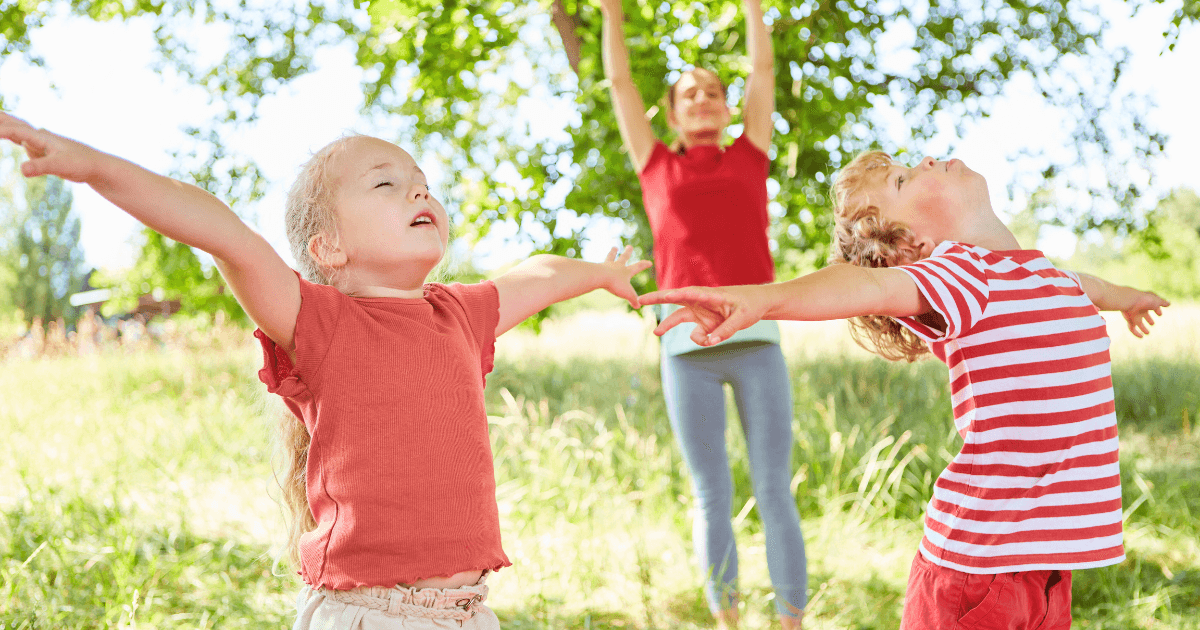
How it works: Children pretend their bodies are balloons. As they inhale, they slowly rise onto their tiptoes, their arms extending upward. As they exhale, they slowly deflate, lowering back down with arms returning to their sides.
Playful variation: Let children choose what color “balloon” they want to be each time.
5. Bumblebee Breath
Materials needed: None
How it works: Children take a deep breath in through the nose, then hum like a bumblebee as they exhale through slightly closed lips. The vibration created has a naturally calming effect.
Playful variation: Let children place their fingers gently on their cheeks to feel the vibration as they hum.
Action for Healthy Kids notes that this breathing technique amplifies sound and vibration, creating a multisensory experience that helps children focus on their breath.
6. Five-Finger Breathing
Materials needed: None
How it works: Children hold up one hand, fingers spread. With the index finger of their other hand, they trace up each finger as they inhale and down each finger as they exhale, creating five full breaths.
Playful variation: Draw faces on each fingertip with a washable marker, “greeting” each finger friend as they trace up and down.
7. Bubble Breathing
Materials needed: Bubble solution and wands (for demonstration)
How it works: After demonstrating how gentle, steady breaths create the best bubbles, children practice the same kind of breathing without actual bubbles. They can pretend to hold a bubble wand and exhale slowly, imagining bubbles floating away.
Playful variation: For outdoor time, provide real bubbles and encourage children to notice how their breath affects the bubbles’ size and movement.
8. Rainbow Breathing
Materials needed: None (optional: rainbow visual)
How it works: Children start with their hands at their sides, then slowly raise their arms up and over their heads as they inhale, forming a rainbow arc. As they exhale, they lower their arms back to their sides.
Playful variation: Name a different color of the rainbow for each breath cycle.
9. Bear Breathing
Materials needed: None
How it works: Children pretend they are bears preparing for hibernation. They breathe in through their nose for a count of three, hold for a count of one, then exhale through their nose for a count of three. The equal ratio of inhale to exhale has a balancing effect.
Playful variation: During winter themes, incorporate this into pretend play about animals in winter.
10. Cookie Breathing
Materials needed: None
How it works: Children pretend to hold a warm cookie (or other favorite food). They breathe in deeply through their nose to smell it, then blow out slowly through their mouth to cool it down.
Playful variation: Let children choose what imaginary treat they’re holding.
Cedars-Sinai recommends this technique as especially effective for children up to age 5.
11. Drain Breathing
Materials needed: None
How it works: Children stand with feet shoulder-width apart, interlace their fingers, and extend their arms up overhead. As they exhale, they slowly lower their arms and upper body, letting them hang loosely toward the floor like water draining from a faucet. They hold this position for a few seconds, then slowly roll back up to standing as they inhale.
Playful variation: Make gentle “whooshing” sounds, like water draining, as they lower.
12. Weather Breathing
Materials needed: None
How it works: Guide children through different breathing patterns based on the weather:
Rainy breath: Soft, steady exhales while fingers flutter downward like raindrops
Snowy breath: Gentle, slow exhales with arms floating down like snowflakes
Windy breath: Strong exhales with swaying movements
Sunny breath: Warm inhale with arms rising like the sun, slow exhale with a smile
Playful variation: Connect to your current weather unit or seasonal themes.
Integrating Breathing Exercises Into Your Daily Routine
For maximum benefit, breathing exercises should become a regular part of the classroom experience, not just emergency interventions. Here are strategies for meaningful integration:
Scheduled Breathing Breaks
Morning meeting: Begin each day with a brief breathing exercise to center the group
Transition times: Use breathing to help children shift between activities
Before rest time: Incorporate calming breaths as part of the rest time routine
After active play: Help children regulate their energy when returning from outdoor time
Responsive Implementation
Early intervention: Suggest breathing exercises when you notice early signs of frustration
Emotional coaching: “I see you’re getting frustrated. Would bunny breaths help?”
Conflict resolution: Guide children through breathing before problem-solving with peers
Group regulation: Use breathing to reset the energy of the whole class when needed
Environmental Supports
Visual cues: Create simple cards illustrating different breathing techniques
Breathing station: Stock your calm-down area with visual reminders about breathing
Class books: Create simple photo books showing children demonstrating different techniques
Family connection: Share breathing strategies with families through newsletters or take-home activities
Supporting Diverse Learners
Children come to breathing practices with different needs, abilities, and experiences. Here’s how to ensure your approach is inclusive:
For Children with Sensory Sensitivities
Offer alternatives to techniques that involve touch
Provide options for children who are uncomfortable closing their eyes
Be mindful of sound levels during group breathing activities
Allow for personal space during movement-based breathing
For Children with Attention Challenges
Keep instructions simple and concise
Use visual supports alongside verbal cues
Start with very brief practice sessions (15-30 seconds)
Incorporate movement into breathing when possible
For Children with Traumatic Backgrounds
Action for Healthy Kids emphasizes the importance of avoiding breath retention (holding the breath) for children with trauma histories, as this can be retraumatizing. Additionally:
Always make participation optional
Avoid language about “controlling” the breath
Emphasize safety and choice throughout the practice
Follow up with grounding activities
For English Language Learners
Use abundant visual demonstrations
Pair verbal instructions with gestures
Create picture cards showing each breathing technique
Teach key vocabulary in multiple languages when possible
Common Challenges and Solutions
Even with careful implementation, you may encounter some challenges when introducing breathing exercises:
Challenge: Children treating breathing time as silly or disruptive
Solution:
Keep initial sessions very brief (30 seconds)
Model a serious but pleasant approach yourself
Acknowledge that learning to breathe mindfully takes practice
Separate children who tend to distract each other
Challenge: Children saying, “This doesn’t work for me”
Solution:
Offer a variety of techniques to find what resonates
Explain that different bodies might need different kinds of breathing
Practice consistently during calm times, not just during emotional moments
Celebrate small successes when breathing does help
Challenge: Difficulty remembering to breathe in emotional moments
Solution:
Create visual reminders throughout the classroom
Establish consistent verbal cues: “Let’s take a breathing break”
Notice and reinforce when children use breathing independently
Practice regularly so the techniques become automatic
Challenge: Parents questioning the value of breathing exercises
Solution:
Share research on the benefits of mindful breathing
Explain how breathing connects to school readiness skills
Provide simple techniques families can try at home
Document and share examples of how breathing has helped in the classroom
Measuring Success: Beyond Behavior Management
While breathing exercises can certainly help with classroom management, their true value extends far beyond that. Here are signs that your breathing practice is having a positive impact:
Individual Growth Indicators
Children independently use breathing techniques when frustrated
Decreased recovery time after emotional moments
Children naming their emotions more accurately
Increased self-awareness about emotional states
Classroom Culture Indicators
More peaceful transitions between activities
Children reminding each other about breathing strategies
As early childhood educators, we have the privilege of introducing children to tools they can use throughout their lives. Mindful breathing is one such tool—simple enough for a three-year-old to learn, yet powerful enough to serve them well into adulthood.
When we teach young children to connect with their breath, we’re not just helping them manage behavior in our classrooms. We’re helping them develop body awareness, emotional literacy, and self-regulation skills that will support their well-being long after they leave our care.
The beauty of mindful breathing lies in its simplicity and accessibility. No special equipment is needed, no curriculum must be purchased, and no extensive training is required to begin. Just a few minutes of playful practice each day can help children develop a lifelong relationship with their breath as a source of calm, center, and control.
As one preschool teacher shared: “Of all the strategies I’ve implemented over my twenty years of teaching, mindful breathing has had the most profound impact—not just on the children, but on me as well. There’s something powerful about an entire classroom taking a moment to breathe together. It reminds us that beneath all the activity and learning, we’re human beings sharing space and caring for one another.”
What breathing exercises have worked well in your classroom? Share your experiences in the comments below!