Inside a Waldorf Classroom: What Makes This Approach Unique
Have you ever walked into a space and immediately felt a sense of calm wash over you? That’s the experience many parents describe when first entering a Waldorf classroom. With its soft colors, natural materials, and thoughtfully arranged environment, a Waldorf classroom stands in stark contrast to the primary-colored, plastic-filled, technology-filled spaces that dominate many conventional schools today.
But what exactly makes Waldorf education so distinctive? Founded by Austrian philosopher Rudolf Steiner in 1919, this century-old approach has been quietly gaining popularity, with over 1,200 Waldorf schools now operating in 75 countries. According to a study published in Frontiers in Education, Waldorf-inspired schools are showing impressive academic outcomes, particularly in the later grades, despite their unconventional methods.
Let’s take a journey inside a Waldorf classroom to discover the unique elements that define this holistic educational approach.
The Physical Environment: A “Living Room” for Learning
The moment you step into a Waldorf classroom, you notice the difference. Unlike the institutional feel of many traditional classrooms, a Waldorf space feels more like a welcoming home.
Natural Materials and Soft Colors
Waldorf classrooms feature:
Walls hand-painted in soft, watercolor-like washes of pink, peach, or gentle blue
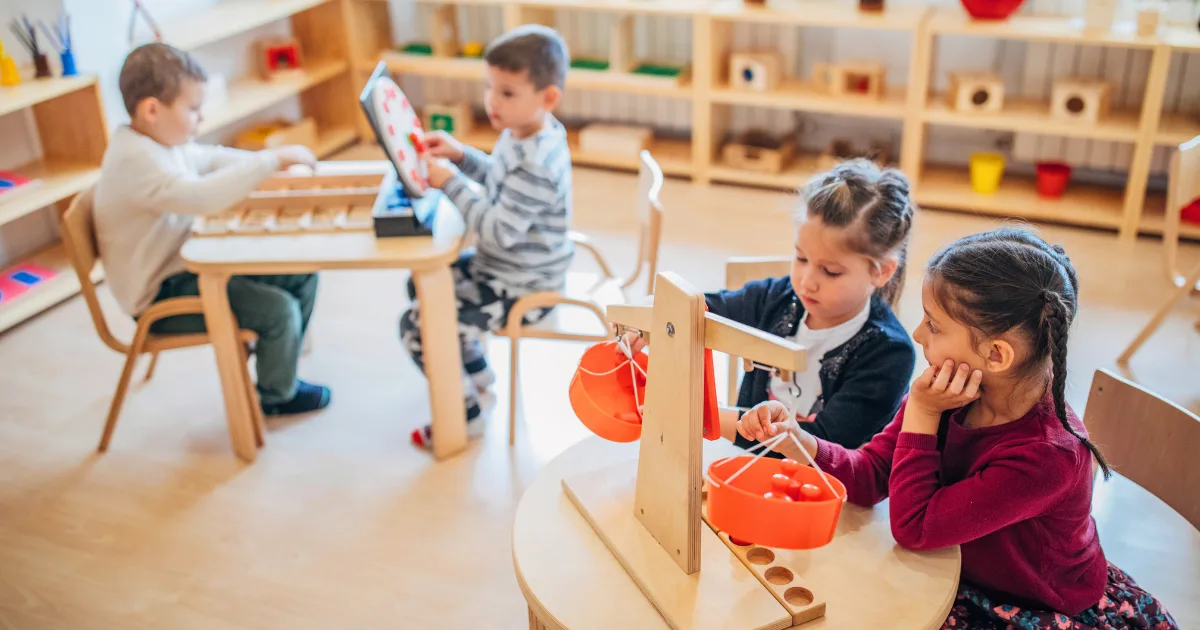
Wooden furniture, often handcrafted and sized appropriately for children
Natural fiber curtains that filter sunlight into a warm, golden glow
Nature tables displaying seasonal treasures: pinecones, shells, stones, and flowers
Handmade dolls with minimal facial features to encourage imagination
Wooden toys, silk scarves, and simple objects that can transform into anything in a child’s mind
As River Song Waldorf explains, “The classroom environment is designed to be beautiful, warm, and home-like, creating a secure feeling for children.” This aesthetic isn’t merely decorative—it’s pedagogical. The natural materials provide rich sensory experiences, while the simplicity of toys encourages creative play and imagination.
What You Won’t See
Just as notable as what’s present in a Waldorf classroom is what’s absent:
No plastic toys or synthetic materials
No electronic screens or digital technology
No commercial characters or branded items
No alphabet posters or number charts on the walls (in early childhood classrooms)
No desks arranged in rows facing a teacher’s desk
This deliberate absence of certain elements creates a space free from distraction and commercial influence, allowing children to be fully present in their learning environment.
The Rhythm of the Day: Breathing In and Breathing Out
A visitor to a Waldorf classroom might be struck by the predictable flow of activities throughout the day. This isn’t coincidental—rhythm is a cornerstone of Waldorf pedagogy.
Daily Rhythm
A typical Waldorf day follows a pattern that alternates between “breathing in” activities (focused concentration) and “breathing out” activities (expansive movement and free expression):
Morning Circle (20-30 minutes): The day begins with verses, songs, and seasonal movement activities. Children might recite a morning verse while standing in a circle, followed by seasonal songs and finger plays.
Main Lesson (90-120 minutes): The academic heart of the day occurs in the morning, when children are most alert. Rather than switching subjects every 40 minutes, Waldorf students immerse themselves in one subject for an extended block of 3-4 weeks.
Artistic Work: Subjects are taught through artistic mediums—painting, drawing, modeling, movement, and music. Even mathematics and language arts are approached through creative, hands-on activities.
Outdoor Time: Regardless of the weather, Waldorf students spend significant time outdoors every day, connecting with nature and engaging in free play.
Practical Work: Children participate in meaningful activities, such as baking bread, gardening, or handicrafts (knitting, sewing, woodworking), appropriate to their age.
Story Time: The day often concludes with the teacher telling (not reading) a story—fairy tales for younger children, mythology and history for older ones.
According to Straits Waldorf, research indicates “a 20% improvement in focus with consistent daily routines compared to fragmented schedules” and “a 30% reduction in classroom anxiety linked to predictable transitions.”
Weekly Rhythm
Each day of the week has its own character in a Waldorf school:
Monday (Purple/Moon Day): Often includes painting
Tuesday (Red/Mars Day): May feature modeling with beeswax or clay
Wednesday (Yellow/Mercury Day): Often includes handwork like knitting
Thursday (Orange/Jupiter Day): May include form drawing or eurythmy (a unique movement art)
Friday (Green/Venus Day): Typically includes baking or cooking
As RVA Naturals explains, “This weekly rhythm helps children understand the passage of time and creates a sense of security and anticipation.”
The Teacher-Student Relationship: A Journey Together
Perhaps one of the most distinctive aspects of Waldorf education is the relationship between the teacher and the students.
The Class Teacher
In Waldorf schools, a class teacher typically stays with the same group of children from first grade through eighth grade (or at a minimum, for several years). This practice, called “looping,” creates:
Deep relationships between the teacher and students
A strong sense of community within the class
Intimate knowledge of each child’s strengths, challenges, and learning style
Continuity in curriculum and expectations
Research cited by Frontiers in Education suggests that looping “can provide an academic advantage equivalent to two to three months of extra instruction per year.”
The Teacher as Artist
Waldorf teachers approach their work as an art form. They:
Create their own lesson plans rather than following scripted curricula
Tell stories from memory rather than reading from books
Play musical instruments to accompany movement and transitions
Model artistic techniques in drawing, painting, and handwork
Develop their own inner life through meditation and reflection
This artistic approach to teaching requires extensive training. Waldorf teacher preparation includes not only pedagogical study but also personal development in the arts, movement, storytelling, and inner work.
The Curriculum: Head, Heart, and Hands
The Waldorf curriculum is designed to engage the whole child—head (thinking), heart (feeling), and hands (willing).
Early Childhood (Ages 3-6)
In Waldorf kindergartens, you won’t find formal academic instruction. Instead, you’ll observe:
Extensive free play with simple, natural toys
Daily rhythms that include circle time, artistic activities, outdoor play, and rest
Practical activities like baking, gardening, and cleaning
Storytelling, puppetry, and songs that build language skills naturally
According to Waldorf Education America, a systematic review in the Journal of Intelligence analyzed 25 empirical studies and found that loose parts significantly enhance problem-solving, divergent thinking, and academic readiness.
Elementary Years (Ages 7-14)
The elementary curriculum unfolds through:
Main Lesson Blocks: 3-4 week immersive study of a single subject
Main Lesson Books: Rather than textbooks, students create their own beautiful books for each subject
Storytelling: Academic content delivered through narrative and imagery
Movement: Learning reinforced through physical activities and games
Arts Integration: Every subject approached through artistic mediums
A visitor to a Waldorf elementary classroom might observe:
Second graders learning multiplication by skipping, clapping rhythms, and drawing geometric patterns
Fourth graders studying Norse mythology while creating intricate knot designs
Fifth graders reenacting ancient Greek Olympic events as part of their history studies
Seventh graders are writing and illustrating detailed reports on Renaissance figures
Special Subjects
In addition to the main lessons taught by the class teacher, Waldorf students participate in special subjects:
Handwork: Knitting, crocheting, sewing, and cross-stitch
Woodworking: Carving and constructing with wood
Foreign Languages: Often two languages beginning in first grade
Music: Recorder playing, singing, and orchestral instruments
Eurythmy: A movement art unique to Waldorf education that makes language and music visible through gesture
Portfolios of student work showing progress over time
Emphasis on individual growth rather than comparison to standardized norms
This approach allows teachers to honor each child’s unique developmental path while still maintaining high expectations for learning.
The Results: What Research Shows
While Waldorf education has sometimes been criticized for its delay of formal academics, recent research suggests promising outcomes:
A 2024 study in Frontiers in Education found that “Waldorf-inspired charter schools have significantly higher percentages of eighth-grade students meeting or exceeding state standards in English Language Arts (ELA) and math compared to non-Waldorf charter schools.”
The same study noted that “despite lower performance in grades three through five, Waldorf education’s developmental approach leads to improved academic outcomes in later grades.”
Research from the Milwaukee Urban Waldorf School showed an increase in the percentage of students meeting grade level in reading from 26% to 63% within three years.
According to Waldorf Education America, a “longitudinal Australian study followed children from ages 2 to 7 and found that 1-5 hours of active, unstructured play per day predicted significantly stronger self-regulation.”
Beyond academic measures, Waldorf education appears to foster:
Strong intrinsic motivation and love of learning
Creative thinking and problem-solving abilities
Social-emotional skills and empathy
Resilience and self-regulation
Confidence and sense of purpose
Is Waldorf Right for Your Child?
Waldorf education offers a refreshing alternative to conventional schooling, but it’s not for everyone. Consider these factors when determining if it might be a good fit:
Waldorf might be ideal if your child:
Thrives in environments with clear rhythms and routines
Enjoys artistic expression and hands-on learning
Benefits from movement integrated with academics
Needs time to develop at their own pace
Is sensitive to overstimulation
Potential challenges to consider:
The transition to or from conventional schools can be difficult due to differences in curriculum timing
Families who heavily use technology at home may experience a disconnect with the school’s philosophy
The delayed academic approach may concern parents who prioritize early reading and math skills
The emphasis on group cohesion may be challenging for highly individualistic children
Creating Waldorf-Inspired Spaces at Home
Even if a Waldorf school isn’t available in your area, you can incorporate elements of this approach at home:
Simplify your child’s environment by reducing plastic toys and electronic devices
Introduce natural materials like wooden toys, silk scarves, and objects from nature
Establish rhythmic routines that alternate between active and quiet activities
Support imaginative play with open-ended toys and unstructured time
Conclusion: Honoring the Journey of Childhood
In a world increasingly focused on early achievement and technological advancement, Waldorf education offers a counterbalance. In this space, childhood is protected and honored as a valuable time in itself, not merely preparation for adulthood.
By creating environments that nourish children’s senses, engaging their imaginations through storytelling and artistic work, connecting them with the natural world, and providing the security of rhythmic days, Waldorf education seeks to develop not just knowledgeable students, but whole human beings.
Whether you choose a Waldorf school or incorporate elements of this approach at home, the underlying message is powerful: childhood matters, and how we educate our children shapes not just what they know, but who they become.
Have you experienced a Waldorf classroom or incorporated Waldorf-inspired practices at home? Share your experiences in the comments below.